
Bib number photo recognition for race photos
Upload the photos from your event and every participant finds theirs by typing a bib number. The number is read directly from the photo, so the bibs you already print are all you need.
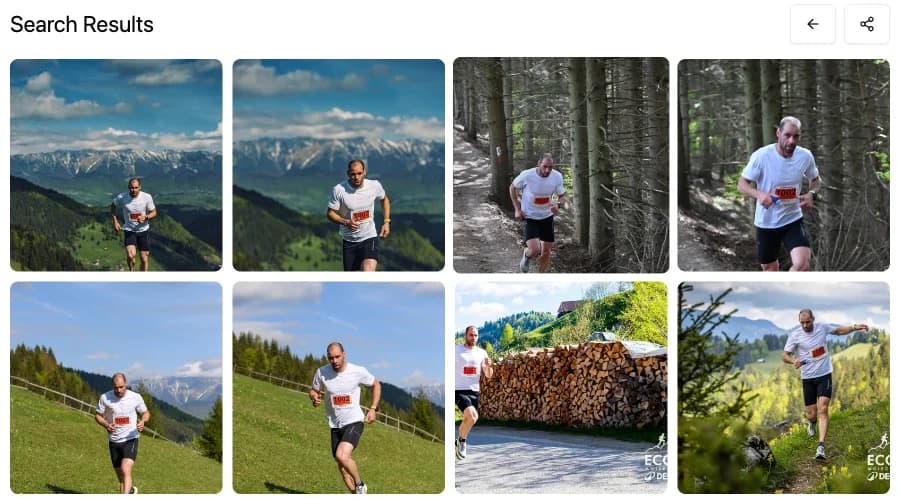
How bib number recognition works
- Read
Read from the photo, no special bibs
The recognition reads the race numbers visible in each photo: the standard digits already printed on the bib. There are no 2D codes to add, no special paper and no change at your bib supplier. Numbers with a letter prefix or suffix work too, for example A-100 or 1A. The detector is chosen by your event type: a motocross race uses separate recognition built for motorsport, not the one used for a running race, because a number on a rider or a machine looks different from a number on a runner's chest. - Filter
Confidence and the valid bib list
A race photo contains more numbers than bibs: sponsor boards, clocks, kilometre markers. Each number read gets a confidence score, and weak reads are left out by a threshold. The list of valid bib numbers you enter for the event, as single numbers or ranges such as 100 to 150, acts as a whitelist: only numbers on that list count as participant bibs. The result is a table of every detected bib with the number of photos it appears in, and an Edit action to review the photos of one bib and remove any that do not belong. - Cover
Hidden, bent or muddy bibs
No detector reads a number that is folded, covered by a jacket or caked in mud. Three things cover those photos. Selfie recognition indexes faces, so a participant whose bib is hidden in one shot is still found by their face in that shot. Manual tags: open the photo, type the bib and, if you want, mark where the number is. Manual tags are treated as certain, they are never filtered by the confidence threshold, and they update search results right away. And the timeline, which places every photo by capture time, so a runner who knows roughly when they passed a photographer can browse that hour.
Recognition is tuned for each sport: why sport-specific wins.
What participants do
Participants open the gallery and type their bib number. Or they upload a selfie and get every photo their face appears in, no bib needed. Or they browse the timeline by day and hour. All three work in the shared gallery and in the widget embedded on your website.
If you are a runner looking for your own photos: go to the website of your event or to the link the organizer shared. The gallery lives there, not on this page.
Where the gallery lives
Two ways to publish. A share link for the whole event or for a single album, which you post on social media, put in the results page or send by email. Or the widget: a two-line embed code, a script tag plus a <photo-album> element, pasted into any CMS that accepts an HTML block, such as WordPress, Webflow or a custom site. Search, timeline and purchases then run on your domain, under your brand, and the widget inherits your page's fonts. The gallery language is set per link or per embed; without one, it follows the visitor's browser language.
<script src="https://myrun.eu/widgets/photos.js" async></script>
<photo-album event-id="..." lang="en"></photo-album>
Live minutes after upload
Photos come in through the browser, from a cloud folder with its subfolders, or straight from the camera over FTP while the race is still running. Recognition starts on each batch as it arrives, and a progress card shows processed and total photos per recognition type. You can keep uploading while a batch is processing; new photos join the queue. How soon participants see their photos depends on when the photos are uploaded, not on a delivery slot.
Private events
Make the event private and choose how participants log in: bib number plus date of birth, email only, an access code, or a selfie. Import the participant list from a CSV. VIP and restricted access opens some albums to some people only.
Selling is optional
Galleries can stay free. If you decide to sell photos, connect Stripe, set your prices and volume discounts, and payments go to your Stripe account. Watermarks protect the previews automatically, as PNG or SVG per orientation or as text labels, until the photo is bought.
Which sports
Event types: Running, including trail; Cycling; Swimming; Triathlon, with duathlon and aquathlon; Fitness; Winter Sports; Motorsport, for motocross, enduro and karting, with numbers on riders and machines; and Other, for corporate events and festivals, where selfie recognition does the job without bibs. Organizers sign up from anywhere in the world. The platform is self-service: create the event, upload, share.
What it costs
- First 5,000 photosFree
- Up to 19,999EUR 0.030
- 20,000 to 49,999EUR 0.025
- 50,000+EUR 0.022
Prices per photo, excluding VAT.
The first 5,000 photos are free: bib and selfie recognition plus 12 months of hosting, every feature included, no card at signup. After that, recognition capacity is bought in steps of 5,000 photos: EUR 0.030 per photo up to 19,999 photos, EUR 0.025 from 20,000 to 49,999, EUR 0.022 from 50,000. Each purchase includes 12 months of hosting. Keeping galleries online longer costs EUR 0.0030 per photo per year up to 19,999 photos, EUR 0.0025 and EUR 0.0022 at the higher tiers. No subscription, no setup fee, no automatic charges. The pricing page shows the list in USD, GBP, CHF, HUF and RON as well.
Data hosting and GDPR
MyRun operates in the European Union. Event data is hosted in EU regions, every organizer can sign a Data Processing Agreement under GDPR Article 28, and face data is processed only to power selfie search for that event; the face templates are deleted together with the photos.
Questions
Do I need special bibs with 2D codes?
No. The recognition reads the standard numbers already printed on your bibs, including numbers with a letter prefix or suffix. A list of valid bib numbers makes the results cleaner, but you do not change anything at the bib supplier.
What happens when a bib is hidden, folded or muddy?
Those photos are covered by selfie recognition, which finds the participant by their face, by manual tags, which you add on the photo and which always count, and by the timeline, which lets a runner browse the photos taken around the time they passed.
How does it avoid wrong matches?
Each number read gets a confidence score and weak reads are dropped. Only numbers on your valid bib list count as participant bibs, so sponsor boards, clocks and kilometre markers are ignored. The bib table shows every detected bib with its photo count, and you can remove a photo from a bib in one click.
How soon can participants search after I upload?
Recognition starts on each batch as it arrives and shows its progress per album; participants can search as soon as a batch is processed, usually minutes after upload. Camera FTP sends photos straight from the camera during the race.
Does it work for cycling, triathlon and motocross?
Yes. The event type you pick at creation tunes the detector: Running, Cycling, Swimming, Triathlon, Fitness, Winter Sports, Motorsport and Other. Motorsport uses a detector built for numbers on riders and machines.
Can participants search on my own website?
Yes. Paste the two-line embed code into any CMS and the whole gallery, with bib search, selfie search, timeline and purchases, runs on your domain. A share link is available too.
Can I keep the gallery private?
Yes. Make the event private and let participants log in with bib number and date of birth, email, an access code or a selfie; import them from a CSV. VIP and restricted access limits specific albums to specific people.
How much does bib number recognition cost?
The first 5,000 photos are free with every feature and 12 months of hosting. After that you buy recognition in steps of 5,000 photos, from EUR 0.030 per photo down to EUR 0.022 at volume, each step with 12 months of hosting. No subscription, no setup fee.
See it on a real event
EcoRun publishes its gallery with MyRun: open the shared gallery, type a bib number or upload a selfie, then see the same gallery embedded on the organizer's own website. When you are ready, create your event and upload the first photos; the first 5,000 are free.